 EN
EN

Nuus
Die EU se nuwe batteryreëling gaan binnekort verpligtend in werking tree — Voldoen u batterye aan die vereistes?
Soos die nakomingsdatum vir die EU-se Batteriereëling nader, het die regulêre toesig oor batterye wat op die EU-mark verkoop word, stadig verskerp. E-handelplatforms het lukraak steekproefinspeksies verskerp, invoerders het ouditprosedures vorentoe geskuif, en handelsmerk-kliënte het vereistes vir volledige nakomingsdokumentasie en duidelike verdeling van aanspreeklikheid onder alle belanghebbendes verhoog.
Vir verbruikers elektronika wat met klein polimeer-litiumbatterye toegerus is, soos TWS-oortelefoontjies, slimhorlosies en AI-brille, is EU-verordening (EU) 2023/1542 nie meer ’n verafgeleë beleid nie. Dit het eerder ’n verpligte marktoegangsvereiste geword om buitelandse bestellings te verseker en ’n langtermyn-stabiele voorsiening te handhaaf.
01 Strenger nakomingsondersoeke op die Europese mark verhoog die hindernisse vir die versending van draagbare batterye
In die afgelope jaar het buitelandse kliënte drasties minder bereidwilligheid getoon om die model „versend eerste, voltooi nougese dokumentasie later“ te aanvaar. E-handelplatforms voer nou streng verifikasies van inligting oor verantwoordelike partye en volledige nakomingdossiers uit; invoerders versnel hul ouditwerkvelle, terwyl handelsmerke nie meer die logika aanvaar dat „gekwalifiseerde selle alleenlik versending toelaat“ nie. Toesig oor die EU-markt het verskuif van bloot die verifikasie van produkverkoopkwalifikasies na die beoordeling van ondernemings se langtermynvolhoubare nakomingvermoëns.
Hierdie verskuiwing het 'n veral ernstige impak op die TWS-oortelefoon-, slimhorlosie- en AI-brilbedrywe gehad. Vroeër het vervaardigers wat hul bedryf oorsee uitgebrei het, hoofsaaklik gefokus op die selontlaai-tempo, dikte, sikluslewe, leweringsvooruitlopie en pryse. Vandag, in die vroeë stadium van samewerking, gee kliënte voorkeur aan die verifikasie van afskakelbare strukturele oplossings, QR-kode digitale inligtingsblaaie, EPR-terugnameprogramme en of die volledige stel nakomingsdokumente 'n geslote-lus-stelsel vorm.
02 2026–2027: Kritieke nakomingsvenster met gefaseerde verpligte vereistes
2.1 Tydlyn van die regulering en sy impak op klein sagte-pakkery-batterye
Die EU-batterieregulering sal in fases toegepas word. Hieronder is 'n uiteensetting van die tydlyne, wetlike grondslag en bedryfsimpakte wat direk van toepassing is op klein polimeerlitiumbatterye vir draagbare toestelle.
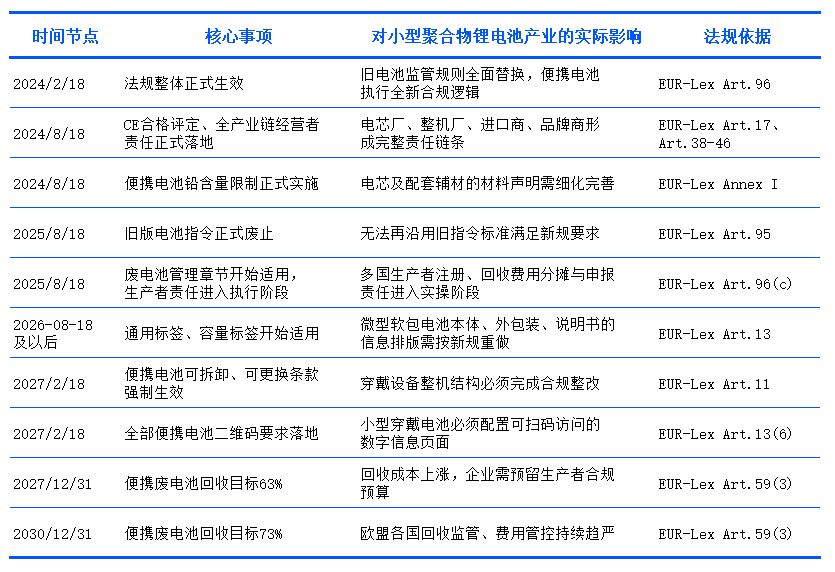
2.2 Konsepverduideliking: Klein draagbare batterye het nie batteriepaspoorte nodig nie — slegs liggewig QR-kode digitale inligtingsblaaie
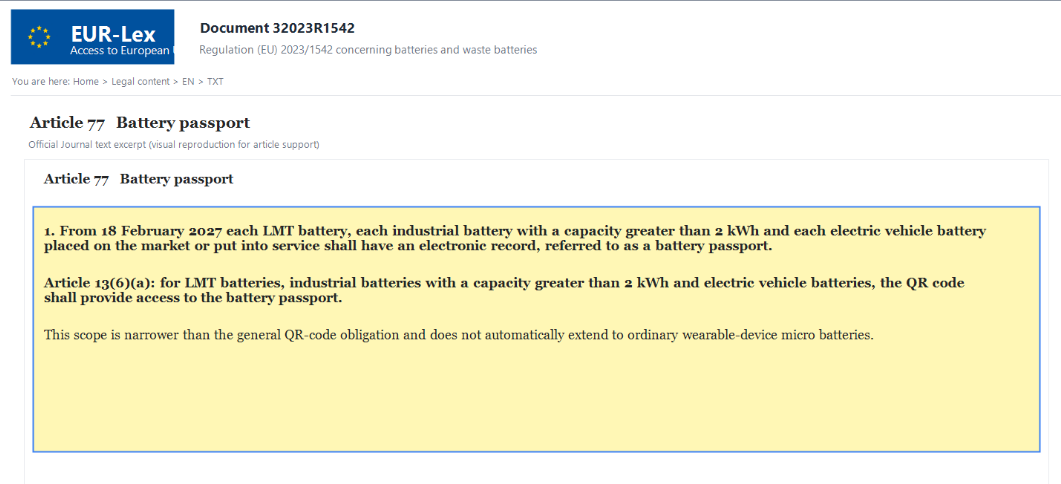
Let op: Verpligte omvang van battery paspoorteDaar is wêreldwye bedryfsverwarring tussen QR-kode digitale inligtingsbladsye en digitale battery paspoorte. Volgens Artikel 77 van die Voorskrif moet vervaardigers van TWS-oortelefoontjies, slimhorlosies en AI-brille slegs liggewigte QR-kode digitale inligtingsbladsye implementeer en is dit nie nodig dat hulle vooraf in voertuiggraad-battery paspoortstelsels belê nie.
03 Ses Kern-nakomingsprobleemgebiede — Strukturele wysiging is die mees algemeen oorheen gesien probleem
Vir klein polimeerlitiumbatterye wat in eindprodukte soos TWS-oortelefoontjies, slimhorlosies, AI-brille en sportbandjies gebruik word, moet ses kategorieë van nakomingshindernisse vooraf aangespreek word, aangesien dit direk invloed het op monsterinvoering, kliëntoudits en oorgang na massa- produksie.
3.1 Verwyderbaarheid van batterye
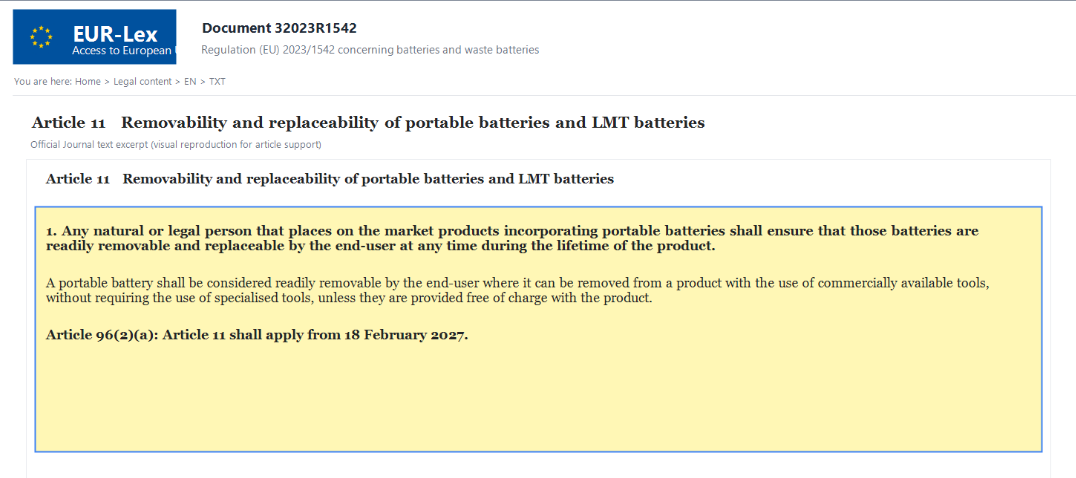
Uittreksel uit die Amptelike Joernaal van die Europese Unie: Verordening (EU) 2023/1542 oor batterye en afgedankte batteryeArtikel 11 Verwyderbaarheid en vervangbaarheid van draagbare batterye en LMT-batterye
- Enige natuurlike of regspersoon wat produkte wat draagbare batterye bevat, op die mark plaas, moet verseker dat sulke batterye tydens die hele dienslewe van die produk maklik deur die eindgebruiker verwyder en vervang kan word. ’n Draagbare battery word as maklik deur die eindgebruiker verwyderbaar beskou indien dit met kommersieel beskikbare gereedskap uit die produk verwyder kan word, sonder spesialis-gereedskap — tensy sulke gereedskap gratis saam met die produk verskaf word. Artikel 96(2)(a): Artikel 11 tree in werking op 18 Februarie 2027.
Let op: Verpligte vereiste vir draagbare batterye om verwyderbaar en vervangbaar te wees
Die meeste onderwaardeerde klousule in die hele regulering is die verpligte reël vir die verwyderbaarheid en vervangbaarheid van draagbare batterye. Die meeste draagbare toestelle maak gebruik van volledig geplakte, geïntegreerde middelraams en hoë waterdigte ontwerpe. Die kernuitdagings by implementering is om nie-destruktiewe batterievervanging moontlik te maak sonder om die produkstruktuur, voorkoms of waterdigtheid te kompromitteer.
Ondernemings kan oplossings evalueer deur eerste drie kernvrae te bevestig:
- Of die produk onder 'n uitsonderingskategorie val;
- Of ontmonteling met gewone gereedskap voltooi kan word;
- Of ontmonteling en hermonteling skerms, antennas, moederborde of waterdigte komponente sal beskadig.
Die klein sagte-pak-batteriesektor tree hoë regstellingsmoeilikheid tegemoet. Hoe kleiner die battery, hoe meer is volledige toestelle geneig om permanent ingebedde strukture te gebruik. Slimhorlosies en AI-brille het dikwels agterdeksels wat met sterk kleefmiddels, waterdigte pakkinge en veelvlakkige inklikstrukture verseël is, met FPC-kabellings wat stewig aan die romp vasgeheg is. Om ruimteoptimalisering in TWS-oortelefoons te maksimeer, word batterykompartemente, klankkomponente en moederborde hoogs geïntegreer. Kliëntoudits fokus nie op teoretiese verwyderbaarheid nie, maar op stabiele, min-beskadigende ontmonteling tydens massa-nabestel-diens.
Volwasse industrie-korrigeringsoplossings is nou beskikbaar: vervang permanent vasgehegte kleefstof met uitrekbare, afskeurbare kleefstof, installeer battery-uittrekblokkies, lei buigsame kabels weg van die battery-uittrekpaaie, skakel volledig geplakte middelraamstrukture om na skroef-en-klip-hibriedstrukture, en skei die agterdekselfering van die batterykompartementontwerp. Shentong Lithium het hierdie oplossings in massa-produksieprojekte vir AI-brille en klein TWS-sagpak-batterye gevalideer.
Ondernemings moet duidelik maak: die verwyderbare ontwerp is nie bloot 'n ná-verkoopkwessie nie, maar 'n fundamentele, volledige-toestelstruktuur wat reeds tydens die produkprojekbeginfase geïdentifiseer en vasgelê moet word.
3.2 Beheer van Gevaarlike Stowwe
Tydens die hantering van die EU 2023/1542-vereistes fokus die meeste inkoop- en SQE-spanne slegs op kernkomponente soos selkathode-materiale, kapasiteit en beskermingsborde. Egter maak bykomende sekondêre materiale die meerderheid van mislukte ewekansige inspeksies uit. Klein materiale soos soldeer, kontakte, kleefstof, etiketink, isolasiemateriale, buiteverpakking en bykomende materiale vir beskermingsborde word dikwels ‘n nalewingsleem sodra kliënte volledige materiaaltraceerbaarheidsdokumentasie versoek.
Miniature draagbare selle het kompakte interne strukture, en OEM’s gebruik dikwels aangepaste bykomende materiale en spesiale prosesse: ultradun dubbelkantige kleefstof, buigbestandige etiketvelle, spesiaalvormige isolasieplate en ultrakort kontaklasprosesse. Aangepaste materiale kan nie direk die verskaffers se standaardmateriaalverklaringsdokumente gebruik nie.
Aanbevole beheerstrategie: vlakbestuur van primêre materiale, aanvullende materiale en buite-ontwerpskomponente volgens risikovlak. Behou lotspesifieke verklarings vir primêre materiale; neem weergawe-veranderings en inligting oor alternatiewe materiale vir aanvullende materiale aan; dwing ‘n gesinchroniseerde veranderingskennisgewingmeganisme vir buite-ontwerpsdele af. ‘n Volledige, duidelike materiaalboek hou risiko’s tydens kliëntoudits en platform se ewekansige inspeksies drasties terug.
3.3 QR-kode digitale inligtingsbladsye
Digitale battery-paspoorte is die afgelope paar jaar wyd bespreek binne die industrie, maar die kern digitale nakomingvereiste vir klein draagbare batterye is nie ‘n volledige paspoortstelsel nie, maar ‘n volledige stel nakomingsinligting wat toeganklik is via ‘n QR-kodeskandering. Verpligte inhoud vir digitale bladsye sluit in modelnommer, kapasiteit, chemiese stelsel, gebruikersinstruksies, riglyne vir herwinningsdoeleindes, toegangsverwysings na ooreenstemmingsverklarings en lottraceerbaarheidslogika.
Byna almal draagbare produklyne vermy die hoë koste van stewige digitale stelsels; ligte digitale inligtingsbladsye lewer 'n laer belegging en vinniger implementering.
Twee kernuitdagings bestaan wanneer digitale bladsye vir miniatuur sagte-pakbatterye geïmplementeer word:
- Beperkte oppervlakte op kale selle verhoed die druk van alle nalewingsdata. 'n Gelaagde inligtingsvertoningskema is vereis: basiese merkings op die sel self, aanvullende besonderhede op die buiteverpakking, en volledige uitgebreide data wat gehuisves word op die QR-kodebladsy.
- QR-kodebladsye kan nie statiese webbladsye wees nie. Hulle moet gekoppel word aan produkmodelle, vervaardigingspartye, handleidingweergawes en toegangspunte tot die CE-verklaring om stabiele datatoekenningsverhoudings te vestig. QR-kodeimplementering is in wese 'n digitale data-ingenieursprojek, nie 'n eenvoudige drukproses nie.
Die digitale nakomingsvereistes ingevolge die EU-batteriereëling verteenwoordig ’n streng transformasietoets vir tradisionele litiumbatterievervaardigers. Benewens die verbetering van die kernselkwaliteit, moet ondernemings toegewyde begrotings toewys om volledige digitale traceerbaarheidstelsels op te bou en eind-tot-eind data-nakomingsvermoëns te ontwikkel.
Vanaf 2023 het Shentong Lithium spesiale fondse belê om ’n eie digitale IT-stelsel onafhanklik te ontwikkel wat hoë-kwaliteitproduksie en doeltreffende lewerings van klein polimeerlitiumbatterye ten volle ondersteun. Die stelsel bied volledige besteltransparansie, eind-tot-eind digitale produksienaksporing en vinnige traceerbaarheid van klaarprodukte na versending.
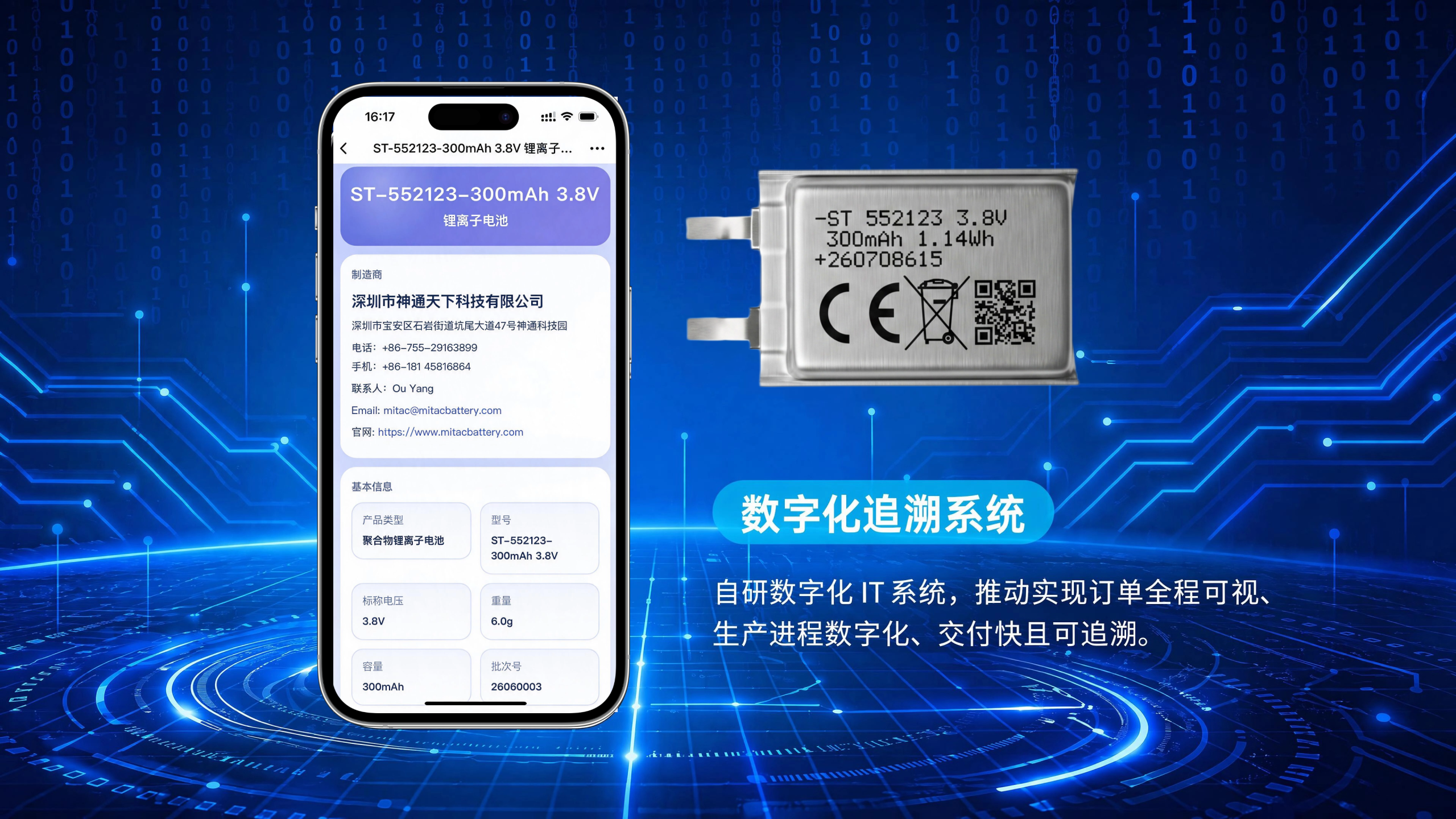
Shentong-digitale-herkomingstelsel Die stelsel verbind multidimensionele kern-data-pype: aan die een kant integreer dit produkspesifikasies, bestelling-batchrekords en nakomingsertifikaatdata om sellbasiese inligting, produksie-batches en EU-nakomingsertifikate as 'n verenigde dataset te koppel. Aan die ander kant konsolideer dit eindproduk-toetsresultate, proseskwaliteitslogs en gestandaardiseerde prosesdata om volledige produksie-siklus kwaliteitsrekords te argiveer.
Hierdie onderling verbonde data-raamwerk bied vinnig oplossings vir die EU-se Batteriereëlingvereistes vir batchherkoming en die terugwinning van nakomingsdokumente, terwyl dit bestellingvolgop en leweringsleidtye verkort. Dit maak volledige proseskwaliteitsbeheer moontlik en verskaf dubbele waarborg vir digitale nakoming en betroubare versending van klein sagte-pakkingslitiumbatterye wat gebruik word in TWS-oortelefone, slimhorlosies en AI-brille wat na die EU uitgevoer word.
3.4 EPR-terugneemverantwoordelikheidstelsel
Enterprises onderskat gewoonlik die koste van EPR-nalewing, met ’n kernmisverstand dat slegs per-eenheid massa herwinningsfooie geëvalueer word, terwyl herhalende vaste uitgawes en bedryfskomplikasies wat voortspruit uit registrasie in verskeie lande, gevolmagtigde verteenwoordigers, jaarlikse verslagdoening en dokumenthandhawing nie in ag geneem word nie. Vir ligte klein polimeer-litiumbatterye is per-kilogram herwinningsfooie selde die primêre finansiële las; kruisgrensregistrasie en volgehoue administratiewe onderhoud dryf langtermynkoste-inflasie. Maatskappye wat op die EU-mark wil fokus, moet EPR-verwante fooie en aanspreeklikheidsaanwysing in hul kosteberekeninge by projekbegin insluit.
'n Alomteenwoordige risikovolle denkwijse binne die draagbare-toestellebedryf: uitstel van EPR-registrasie as gevolg van lae versendingvolume. In werklikheid beteken 'n laer produkvolume dat vaste nakomingskoste oor minder eenhede versprei word, wat per-produk koste verhoog. Die gebrek aan volledige produsentverantwoordelikheidsdokumentasie tydens oudits deur merke, invoerders of e-handelplatforms veroorsaak baie hoër tyd- en administratiewe koste vir terugwerkende registrasie as vir proaktiewe beplanning.
3.5 Spoorbaarheid van grondstowwe en kliëntdue-diligensie
Klein vervaardigers van sagte pakketbatterye skat dikwels die tydlyn verkeerd en neem aan dat dokumentasie vir die spoorbaarheid van grondstowwe tot die regulering se volle verpligting in werking tree, uitgestel kan word. Artikel 47 van die regulering stel egter die effektiewe datum vir batterydue-diligensieverpligting op 18 Augustus 2027, met 'n fokus op risikobestuur oor grondstofversorgingskettings. Kommerciële oudits deur merke en invoerders sal byna sekerlik baie voor hierdie wetlike termyn uitgevoer word.
Die optimale implementeringsstrategie vir klein vervaardigers van polimeer-litiumselle tans is nie om swaarplank-ondersoekraamwerke te herhaal nie, maar om die voltooiing van ’n kritieke materiaallys te prioriteer: stel ’n lys saam van kernverskaffers vir katoedmateriale, koperfolie, aluminium-plastiekfilm en skeidingsmateriaal; bewaar oorsprongsertifikate en nakomingsverklarings vir roumateriale; klassifiseer hoë-risiko beheerde materiale; en voer ’n gesinchroniseerde weergawe-veranderingskennisgewingmeganismus in. Hierdie benadering stem ooreen met kliëntouditvereistes en voorkom dat projekte tydens die oorgang van monsterproduksie na massaproduksie stilgesit word as gevolg van ontbrekende dokumentasie.
3.6 Merkings op kleinbatterieselle
Die primêre hindernis vir draagbare klein sagte-pakbatterye is beperkte drukruimte. Klein selle van 20 mAh, 30 mAh of 50 mAh het ’n minimale oppervlakte en meestal onreëlmatige vorms; die direkte aanvaarding van merkingsstandaarde wat vir groot batterye ontwerp is, lei tot onleesbare klein lettertipes en oorvol inligting.
Die gestandaardiseerde oplossing vir klein sagte-sakbatterye maak gebruik van 'n trapsgewyse inligtingsbestuur: slegs basiese herkommelingskodes en kernidentifiseerders word op die kaal sel gedruk, sekondêre nakomingsinligting word bygevoeg op die buiteverpakking en produkhandleidings, en omvattende dinamiese data word gehuisves op die QR-kode digitale bladsy. Dit vereis kruisfunksionele samewerking tussen selvervaardigers, strukturele ingenieurs, verpakkingsontwerpers, gehalte-spanne en buitelandse handelsdepartemente.
Gebaseer op massaproduksie-industrie-ervaring val die ses nakomingsake in drie impak-kategorieë:
- Direkte belemmeringe vir bestellinglewering: verwyderbare strukturele ontwerp, QR-kode-merkering, geslote-lus volledige nakomingsdokumentasie;
- Langtermyn brutomarginaanpassing: vormverandering, waterdigte prestasieherontwerp, battery-uittrekkonstruksies, spesiale ontmonteergeraatskappe, etiketoorherstel, handleidingherdrukking, toegevoegde herwinningfooie;
- Kernbeoordelingskriteria vir verskafferondersoek: materiaalkompatibiliteitsverklarings, eind-tot-eindtraceerbaarheidsvermoëns, en kruisdepartementele kompliansiesamewerkingsvermoë.
Ondernemings moet regulêre klousules ontbind in drie uitvoerbare werkstrominge — produkstrukturele aanpassings, dokumentvoltooiing en projekprosesoptimalisering — en dit volgens prioriteit voortdryf.
04 Ontleding van inkrementele kompliansiekoste: Volledige-toestelstrukturele wysigings verteenwoordig die grootste uitgawepost.
4.1 Liggewig digitale inligtingsbladsye: Elimineer swaar stelsels om digitale-investering vir MKB’s te verminder.
Die kernlogika vir die beheer van digitale kompliansiekoste: draagbare produklyne is vrygestel van die implementering van grootskaalse battery-passpoortstelsels. Liggewig QR-kode digitale inligtingsbladsye het laer kapitaaluitgawes en lewer ‘n beter opbrengs op investering vir klein- tot mediumgrootteselle- en OEM-vervaardigers.
4.2 EPR Terugneemkostebreakdown: Ondergeskatte Vaste Fooie vir Registrasie in Meerdere Lande en Jaarlikse Agentskapsfooie
Al lyk die per-kilogram EPR-herwinningstariewe laag, word herhalende vaste koste soos registrasie in verskeie lande, vergoeding vir ‘n EU-geoutoriseerde verteenwoordiger, jaarlikse verslagdoening en dokumenthandhawing dikwels deur ondernemings geïgnoreer, wat tot beduidende langtermyn-nakominguitgawes optel. Afskrywingkoste moet vooraf tydens nuwe produkontwikkeling beraam word.
4.3 Volledige-toestel-strukturele wysigings is die grootste nakomingkoste
Die meeste maatskappye glo foutelewys dat inkrementele nakomingkoste hoofsaaklik voortspruit uit hoër selinkooppriese. In praktyk ontstaan die grootste uitgawes egter uit volledige-toestelherstelwerk: herstrukturering van die agterdekking en middelraam, hervalidering van waterdigheid, meganismes vir batteryverwydering, spesiale ontmonteerinstrumente, etiketontwerp, herdruk van handleidings en toegewysde herwinningsfooie.
4.4 Gewone inkrementele nalewingskosteposte vir draagbare produkte (vir projekevalueringsverwysing)
|
Kostepost |
Bedryf se geskatte uitgawe |
Aanvullende Notas |
|
Voltooiing van volledige tegniese lêers, insluitend CE-sertifikate en verklarings van ooreenstemming |
RMB 8 000–25 000 per model |
Koste verminder met reeds bestaande, volledige nalewingsdokumentasie |
|
Nalewingsoordrag en toetsing van roumateriale |
RMB 5 000–12 000 per model |
Hoër koste vir produkte met uitgebreide aangepaste bykomende materiale |
|
SaaS-stelsel vir liggewig QR-kode digitale inligtingsbladsye |
RMB 8 000–30 000 per jaar |
Optimeer vir liggewig-deployment van draagbare klein batteries |
|
Eenmalige opgradering van die produksielyn vir QR-kode-merking en produkdata-bindings |
RMB 5 000–20 000 |
Dek druktoerusting, steekproefinspeksie en groepdata-bindingswerkvelle |
|
Jaarlikse nakomingdokumentoudit, opdatering en onderhoud |
RMB 10 000–30 000 per jaar |
Bykomende koste vir vervaardigers wat verskeie modelle gelyktydig vervaardig |
|
EU-gevolmagtigde verteenwoordigerdiensfooi |
RMB 6 000–15 000 per onderneming per jaar |
Wissel volgens omvang van aanspreeklikheidsdekking |
|
Multi-land EPR-registrasie- en jaarlikse verslagdoeningagentskapsdiens |
Wissel volgens die aantal teikenlande en diensomvang |
Hoër fooie vir ondernemings wat na meer EU-gebiede versend met groter uitsetvolume |
|
Herstelvervaardiging en wysiging van volledige-toestelvorms |
Wissel volgens projekkompleksiteit en omvang van strukturele aanpassings |
Laer regstellingskoste vir TWS-oortelefoontjies; hoër koste vir slimhorlosies en AI-brille |
Ervaring met bedryfsprojekte toon dat direkte BOM-koste-verhogings wat deur die regulering veroorsaak word, selde die primêre drukpunt vir draagbare produkte is. Die grootste winsvermindering ontstaan gewoonlik uit eens-in-’n-tyd-vormontwikkelingsfooie, strukturele herwerk en verskeie rondtes van herontwerp as gevolg van ontoereikende voorbeplanning tydens die produkinitiasie-fase.
05 Geslote-lus Volledige-Ketting Nalewingsaanspreeklikheid: Herstrukturerede Evaluasiestandaarde vir Klein Polimer-litiumbatterylewerders
5.1 Duidelike Toeleweringskettingaanspreeklikheidsuitoefening — Geen onderlinge ontwyking van verantwoordelikhede nie
Die EU-batteriereëls vereis afsonderlike ooreenstemmende aanspreeklikhede vir alle operateurs langs die waardeketting:
|
Verantwoordelike party |
Kernverpligtinge |
Risiko Gevolge |
|
Selvervaardiger |
Egte materiaalverklarings, onoorgedrewe selspesifikasies, opspoorbare vervaardigingspartye |
Direkte regsgeweldige aanspreeklikheid vir vals kritieke materiaaldata of misvoorstelde selparameters |
|
OEM / Merkeienaar |
Nakomende verwyderbare volledige-toestelontwerp, gestandaardiseerde merkingsdrukwerk, funksionele QR-kodebladsye, nakomende gebruikershandleidings |
Douane-inbeslagname, platformprodukuitskakeling, kliëntopskorting van produkintroduksie vir nie-nakomende strukture of merkings |
|
Invoerder / Merklisensiehouer |
Volledige EU-EPR-registrasie, tydige herwinningsfooi-betaling, jaarlikse nakomingsverslae |
Marktpenalties, verkoopbeperkings, aanspreeklikheidseise van kliente vir ontbrekende terugneem-dokumentasie |
5.2 Optimale regstellings tydlyn: Proaktiewe beplanning in 2026, volledige nakoming se implementering voor 2027
Die bedryf se debat draai om volledige eenmalige oorhersienings teenoor gefaseerde regstellings. Die optimale pad vir die meeste draagbare toestelvervaardigers is 'n ligte, gefaseerde implementering:
- 2026: Voltooi strukturele voor-navorsing, implementeer QR-kode digitale inligtingsbladsye, sorteer BOM-materiaalnakomingsrekords, en finaliseer EPR terugneem-padwyse;
- Voor die verpligte datum van Februarie 2027: Voltooi massaproduksie-vormveranderings, gestandaardiseerde merkings op finale produkte, formele naverkoop-ontmonteringswerkvelle, en sluit die volledige nakomingsdokumentasiesiklus af.
5.3 Verskillende regstellingsprioriteite vir drie draagbare produkategorieë: AI-brille / TWS-oortoestelle / Slimhorlosies
Gebaseer op massaproduksieprojekgevalle wat deur Shentong Lithium geïmplementeer is, verskil die kernkorrigeringfokus beduidend oor die drie hoofdraagbare segmente:
- KI-brille: Balans ultra-ligte chassisonwerp met onderhoubare, afskakelbare batterystrukture;
- TWS-oorkoppies: Aparte ontmonteringskemas vir laaihulsel en oorkoppie-liggame; los ruimtebeperkings op wat die installasie van trekstrokie binne die klein oorkoppieholtes verhoed;
- Slimhorlosies: Primêre koste en strukturele aanpassings is gekonsentreer op die herontwerp van die agterdek, waterdigheidvalidering en die herberekening van die meganiese prestasie van die middelraam.
5.4 Nuwe Kernevalueringsmetriek vir Selverskaffers: Kruisfunksionele Nalewingsondersteuningsvermoë
Vroeër het OEM’s selleverskaffers slegs op grond van kapasiteit, dikte, pryse en leweringsvooruitgangsdae beoordeel. Na die handhawing van die EU-batteriereëling het samewerklike nakomingsteun-kapasiteit ‘n kernkriteria vir keuring geword, wat oor ses dimensies geëvalueer word: vermoë om volledige materiaalnakomingverklarings uit te reik, samewerking met betrekking tot CE-dokumentasie, versoenbaarheid met gestandaardiseerde QR-kodevelde, gesamentlike hersiening van verwyderbare strukture, massaproduksie-batchsporeerbaarheid, en voorsiening van ondersteunende EPR-dokumentasie.
06 Gevolgtrekking
Vir klein polimeer-litiumbatteryondernemings wat fokus op TWS-oortelefoon, slimhorlosies en AI-brille, is die 2026–2027-venster nie meer ’n keuse of nie EU-nakoming bereik moet word nie — maar ’n toets van of nakomingvermoëns voor die finale produkspesifikasies van kliente vasgestel kan word. Laatstadium-vormherstellings, aanvullende dokumentinlæg, nagelike terugneemregistrasie of herontwerpte ná-verkoop-ontmonteringswerkvelle voor verpligte datums lei onvermydelik tot baie hoër koste as voorafseggende navorsing by projekbegin.
Mededingende verskille word nie meer slegs bepaal deur een-sel kapasiteit, dikte of eenheidsprys nie. Die sleutelmededingende voordeel lê in ’n verskaffer se vermoë om gelyktydig strukturele optimaliseringsaanbevelings, materiaalboekhoure, QR-kode-inligtingsbladsy-raamwerke, partyspoorbaarheidskoppelvlakke en reaktiewe dokumentasie-ondersteuning vir invoerders en handelsmerk-kliënte te lewer. Toekomstige verskaffertoetsing vir klein polimeerlitiumbatterye vir die EU-mark sal toenemend ’n omvattende einde-tot-einde-leweringvermoë evalueer, eerder as geïsoleerde komponentparameters.
‘n Toekomsgewigte opstelling vir gespesialiseerde vervaardigers soos Shentong Lithium behels nie blindelings belegging in swaar-batesstelsels nie. Dit behels eerder die verdyping van kernvermoëns vir klein sagte-pak-projekte: samewerklike verwyderbare strukturele ontwerp, liggaam-af digitale inligtingbladsy-implimentering, volledige nalewingsboeke vir kritieke materiale en gestroomlynde kruisdepartementele reaksie-meganismes. Kennis van eenmalige projekkorreksies word omgeskakel na herbruikbare, herhaalbare leweringsvermoë vir die EU-mark.